ESSENTIAL OILS AND SWINE NUTRITION
Essential oils are a mixture of extremely volatile aromatic molecules with a complex composition, obtained by extraction from plants and plant derivatives.
From a chemical point of view, essential oils can vary in their composition.
Each molecule composing the essential oil contributes an individual effect to a well-defined biological activity of the essential oil itself.
For example, carvacrol and thymol, the main components of essential oils extracted from plants of the Lamiaceae family (oregano, thyme, rosemary, etc.), are attributed notable antibacterial properties demonstrated in vitro, whereas p-cymene, a component present at a lower concentration, although it does not possess intrinsic antimicrobial activity, is attributed the ability to facilitate the transport of thymol and carvacrol through the pathogen’s plasma membrane, thus contributing to the antimicrobial effect of the essential oil.
The antimicrobial power of carvacrol and thymol is linked to their ability to disrupt the stability of cell membranes, leading to membrane collapse with consequent loss of intracellular contents and therefore to bacterial cell death.
Although these are very similar molecules with a recognized antimicrobial role, the different position of the functional groups in their molecular structure confers different effects on Gram-positive or Gram-negative bacteria.
ESSENTIAL OILS AND ANIMAL NUTRITION
The use of essential oils in animal feeding to support intestinal health has proven to be one of the most important applications of these substances.
Some essential oils, especially those derived from spices such as cinnamon essential oil, promote feed digestion by stimulating the production of bile and digestive enzymes.
Zeng et al. conducted a study on diets for weaned pigs, comparing the performance of animals fed a standard energy diet (3,400 kcal/kg) with that of animals fed a low-energy diet (3,250 kcal/kg) supplemented with 0 or 0.25 g/kg of cinnamon and thyme essential oils (4.5% cinnamaldehyde and 13.5% thymol).
The performance observed in pigs fed the low-energy diet supplemented with essential oils, in terms of weight gain, was very similar to that of pigs fed the standard energy diet and markedly better than that recorded in pigs fed the unsupplemented low-energy diet.
Supplementation with essential oils improved the digestibility of dry matter and crude protein, thereby enhancing performance.
The positive effects of essential oils on digestibility contribute to the maintenance of intestinal health, as better digestion prevents the accumulation of fermentable substances in the ingesta that could be used by potentially pathogenic bacteria to proliferate and give rise to dysbiosis resulting in intestinal dysfunctions such as diarrhea, etc.
ESSENTIAL OILS AND THE FIRST POST-WEANING PERIOD

Several studies demonstrating the modulatory effect of essential oils on intestinal ecology have been conducted during the first post-weaning period of piglets.
Supplementation with essential oils during this delicate phase has proven useful in counteracting the negative effects induced by the transition from a liquid to a solid diet.
An incorrect nutritional management can in fact open scenarios such as the proliferation of pathogenic bacterial species and the onset of post-weaning diarrhea.
The ability to modulate the intestinal bacterial flora, together with the antioxidant action of the aromatic molecules contained in essential oils—important in helping to counteract the production of free radicals following the stress caused by dietary change—has proven to be a useful application in supporting this transition period.
ESSENTIAL OILS AND SOW NUTRITION
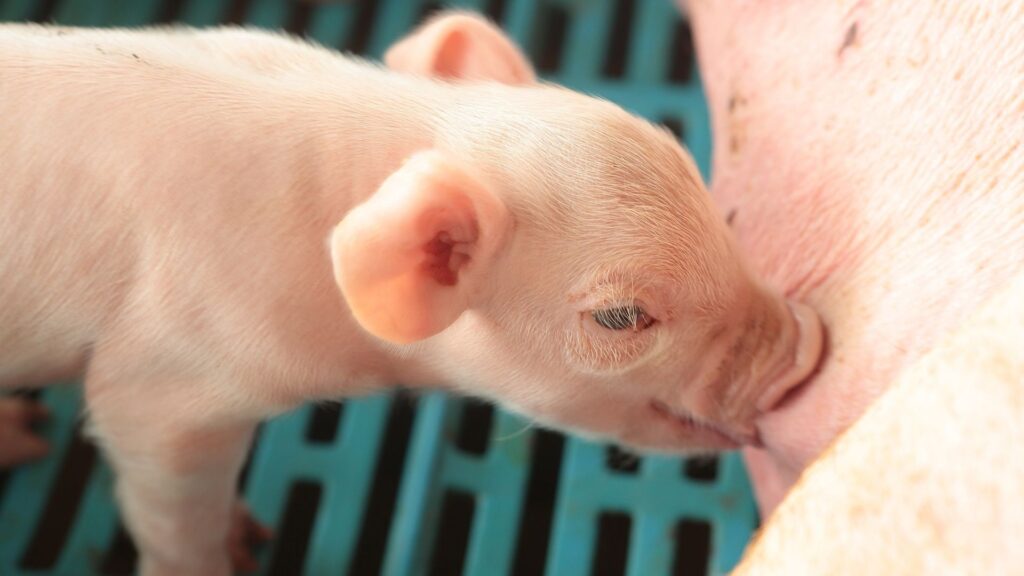
The integration of essential oils into swine diets has also been investigated with regard to their use in sow diets, to test their beneficial effects on breeder performance.
In general, their use has proven useful in stimulating sow appetite and improving feed utilization following favorable modifications of intestinal ecology.
Modifications that, although they may appear of limited significance, translate into improved animal welfare and reduced weight loss of the sow during the first week of lactation.
ESSENTIAL OILS AND THE IMMUNE SYSTEM
The close connection between the microbial populations composing the intestinal microbiota and the animal’s immune system is increasingly studied and proven.
It is therefore not surprising that there is a correlation between modifications of the intestinal microbiota induced by essential oils and changes in the distribution of lymphocytes at the intestinal level.
The gastrointestinal tract is closely connected to what is defined as gut-associated lymphoid tissue (GALT), which contains the largest mass of lymphoid tissue in the animal body and plays an essential role in preventing the entry of the most common pathogens.
Modulation of the intestinal microflora would result in a reduced need for immune defense at the intestinal level, with a lower distribution of lymphocytes in this area.
Lower immune pressure at the intestinal level could also partly contribute to directing essential nutrients toward animal growth rather than immune defenses.
In addition, several parameters indicating the immune status of the animal, such as the number of circulating lymphocytes, the phagocytosis rate, and the number of immunoglobulins produced, can be modified by dietary supplementation with essential oils.
These modifications are dose-dependent and may vary according to the more or less marked synergistic action that can occur among the various components of the essential oils used.