The Latest Studies on Heat Stress and Pregnancy in Dairy Cows
Negative Effects on the Productive Performance of Future Generations
Recent research has examined the productive performance and profitability of two future generations of cows born to dams exposed to heat stress during pregnancy.
The results show that maternal hyperthermia during late gestation alters the performance of daughters across multiple lactations. As is well known, heat stress has a significant effect on dairy cows, negatively impacting milk production, reproductive performance, herd health status, and increasing involuntary culling rates. In the United States, this results in losses of approximately 1.5 billion dollars per year.
According to a study conducted in the United States, the impact of heat stress is long-lasting and continues to influence the performance of the offspring of heat-stressed cows for two generations.
It has already been demonstrated that cows born to dams exposed to heat stress during the final phase of pregnancy show reduced growth and produce on average 5 kg less milk per day during their first lactation.
Heat Stress and a Summer Management Plan: Download the Magazine
Even if it arrived later this year, the hot season has come, bringing with it all the problems related to heat stress that can affect the herd.
Right on time comes the Tecnozoo magazine dedicated to the summer period, where you can discover the best on-farm strategies to cope with heat.
In addition to this article, in this issue you will find:
Uterine health during the summer period: evaluating the incidence of metritis and endometritis (Research presented at ADSA, July 2019 (ADSA Abstract # 403).
Calf management: protocols to best address the summer period.
Milk Production and Reproductive Performance of the Two Generations Studied
The study conducted by Laporta et al., 2020 had two objectives:
1) To measure the carryover effect of maternal exposure to heat stress during the final period of pregnancy on milk production, reproductive performance, and survival rate of daughters and granddaughters.
2) To estimate the economic losses associated with these outcomes in the United States.
Over a 10-year period, data were collected on the performance of Holstein cows in Florida, the U.S. state with the highest number of heat stress days per year. Information was collected on longevity, productivity, and reproductive performance of two successive generations of cows born to dams exposed to heat stress during pregnancy, and of those born to dams cooled during summer.
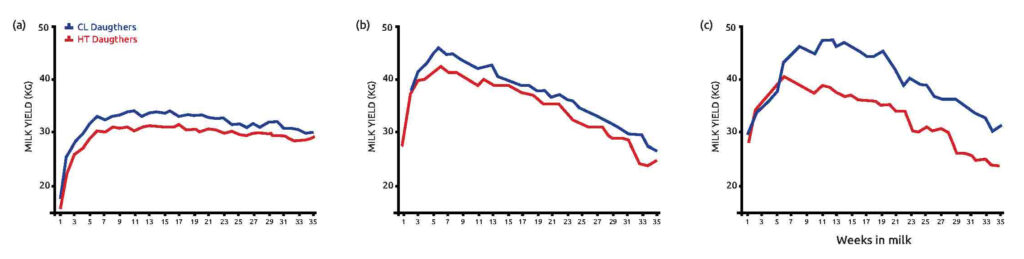
The cows in Figure 1 were divided by parity. CL animals are daughters born to dams cooled during the last phase of pregnancy (~46 days) under heat stress conditions (shade, fans, and sprinklers), while HT animals were born to cows provided with shade only. All cows were cooled during the three lactations. As shown, the production loss is evident in all three lactations.
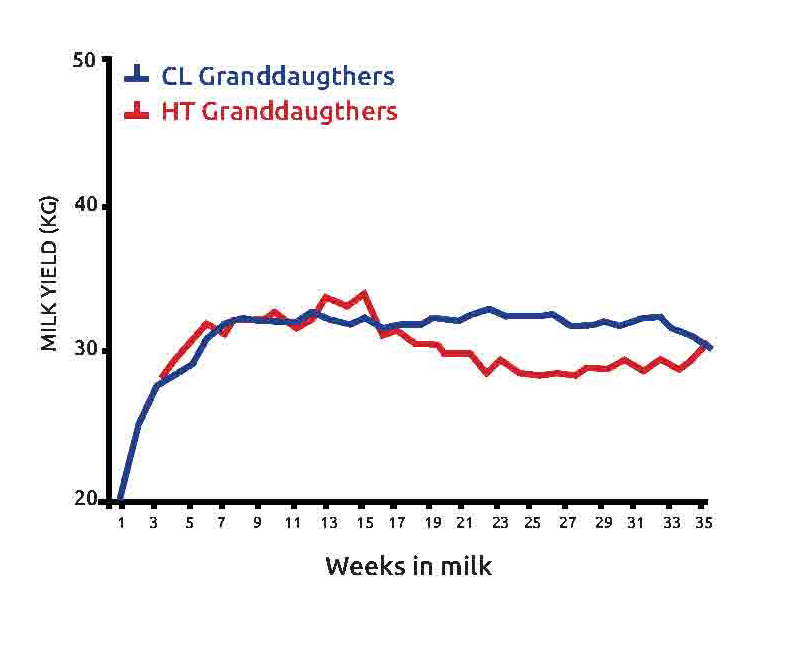
Daughters of cooled cows produced in first lactation +2.2 kg/head/day (31.4 vs 29.2); in second lactation +3.3 kg/head/day (36.7 vs 34.4); in third lactation +6.5 kg/head/day (39.6 vs 33.1). Milk production persistency in granddaughters (Figure 2) was also partially compromised, with a more pronounced reduction in milk yield in those not cooled. In an average U.S. dairy herd with daughters (35% primiparous, 20% second lactation, and 14% third parity) born to cows exposed to heat stress during late gestation, losses amount to 120 kg of milk per lactation.
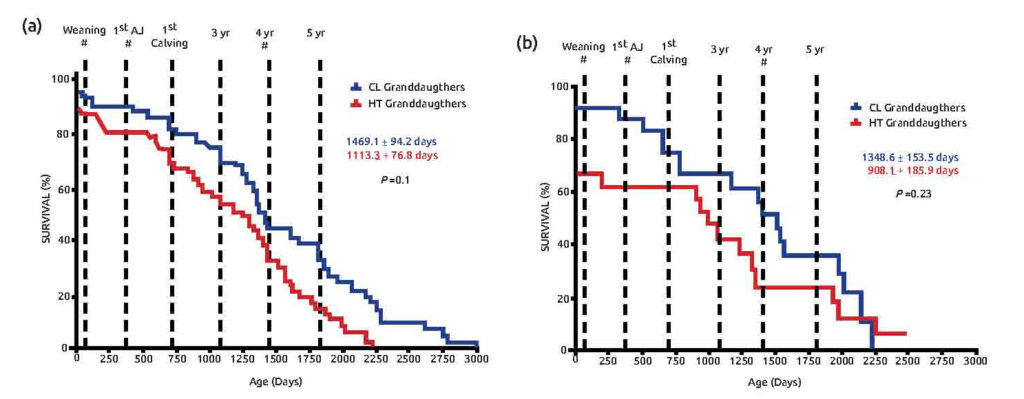
Daughters and granddaughters of heat-stressed cows showed negative effects on survival rate (Figure 3) from birth to first calving, length of productive life, milk yield, and milk components across three lactations.
These effects translated into a considerable increase in costs for dairy producers, with national losses reaching up to 595 million dollars per year.
These findings confirm the need to optimally manage heat stress also in dry cows. According to Laporta (Department of Animal Sciences – University of Florida), this research suggests the presence of a permanent effect of the fetus/environment interaction on gene expression in adulthood.