Albumen Quality

ALBUMEN QUALITY
FACTORS AFFECTING ALBUMEN QUALITY
When a fresh egg is broken onto a surface, two portions of albumen can be distinguished:
- Thick albumen, i.e. the portion that supports the yolk: the denser, gelatinous layer, resulting from the interaction between proteins, ovomucin, and lysozyme.
- Thin albumen, the more fluid layer with a watery consistency that spreads over the surface.

The amount of thick albumen, its thickness, and its consistency are important indicators of egg quality and freshness.
These characteristics are expressed numerically by the HU (Haugh Unit) , a numerical value ranging from 0 to 100, resulting from the ratio between the height of the thick albumen and the weight of the egg.
The lower the HU value, the poorer the egg quality.
LIQUEFACTION OF THE ALBUMEN
The deterioration of eggs during storage involves an increase in the size of the air cell, lipid peroxidation, and a decrease in consistency.
During egg storage, water and carbon dioxide are released through the pores of the shell.
This release leads to an increase in albumen pH, with a consequent negative effect on the protein bonds that give consistency to the thick albumen; as these bonds are altered, the albumen becomes more liquid in consistency.
Albumen liquefaction is a natural process that increases with product aging; however, it is well known that animal genetics, health status, environmental conditions, feed composition, and drinking water quality can also negatively influence it.
To improve albumen quality and counteract the natural deterioration of the egg, several nutritional strategies have been proposed over time.
Manipulation of protein balance and acid–base balance appears to be the most effective, but proper supplementation with trace elements and antioxidant substances has also proven effective.
SUPPLEMENTATION WITH TRACE ELEMENTS AND ANTIOXIDANT SUBSTANCES
In conditions of increased oxidative stress, such as heat stress or aging, free radical production rises significantly and the quality of the eggs produced worsens.
In cases of increased oxidative stress, dietary selenium supplementation meets the increased requirement for the production of selenoproteins, which are components of antioxidant enzymes such as peroxidases.
To strengthen these mechanisms, supplementation with antioxidant substances such as vitamin E, vitamin C, and natural phytocomplexes can also be used.
The intake of zinc and manganese, in both organic and inorganic forms, has also been shown to support the body’s antioxidant mechanisms; moreover, several studies show that diets supplemented with zinc and manganese increase shell strength.
Supplementation of selenium, zinc, and manganese in the diet also increases the concentration of these elements within the egg, contributing to improved egg quality thanks to the antioxidant role they continue to play inside it, counteracting the common processes that degrade its quality.
TECNO EGG FRESH
Tecno Egg Fresh contains all the above-mentioned components, and their dietary supplementation—especially during periods of increased oxidative stress, when albumen quality or, more generally, egg quality declines—can represent valuable support for animal metabolism.
MANIPULATION OF ACID–BASE BALANCE
Especially during the summer months, animal heat stress, combined with the difficulty of maintaining optimal egg storage conditions, significantly accelerates albumen liquefaction.
Factors that positively influence quality by limiting liquefaction phenomena include the acidification of both the animal’s drinking water and diet.
 |
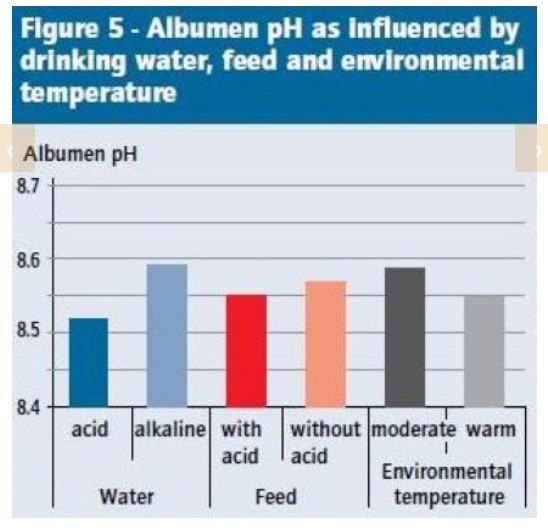 |
| Fig. 1 Influence of water and diet acidification and environmental temperatures on albumen height expressed in mm | Fig. 2 Influence of water and diet acidification and environmental temperatures on pH |
Studies conducted on the effects of pH on albumen quality, in diets supplemented or not with organic acids, are very encouraging.
Dietary acidification, together with water acidification—especially during hot periods—positively influences albumen quality, resulting in higher HU scores.
BIBLIOGRAPHY
- Dunn – “Poultry breeding for egg quality: traditional and modern genetic approaches: Improving the Safety and Quality of Eggs and Egg Products: Egg Chemistry, Production and Consumption”, 2011
- F. G. Silversides and K. Budgell – “The Relationships Among Measures of Egg Albumen Height, pH, and Whipping Volume”
- M. S. Rahman , M. A. R. Howlider , M. Mahiuddin and M. M. Rahman- “Effect Of Supplementation Of Organic Acids On Laying Performance, Body Fatness And Egg Quality Of Hens”
- Pasquoal Carrazzoni de Menezes; Evilda Rodrigues de Lima; Juliana Pinto de Medeiros; Wanessa Noadya Ketruy de Oliveira; Joaquim Evêncio-Neto – “Egg quality of laying hens in different conditions of storage, ages and housing densities”
- K.C.Williams – “Some factors affecting albumen quality with particular reference to Haugh unit score”